
How to Prepare for an Analytics Engineering Interview
A practical guide from HR screen to final round

Recently, I asked my followers on LinkedIn:
“Which part of the interview process feels the hardest?”
Here are the top three answers:
Data modeling (65%)
Technical round (49%)
I’m not sure what companies expect (32%)
The first two are fairly obvious. Technical expertise is the foundation of any analytics engineering interview, and data modeling is increasingly becoming a core skill (something Joe Reis has been actively advocating for).
What surprised me most, though, is that nearly 33% of candidates don’t know what companies are actually evaluating. On top of that, almost 54% said they’ve failed at least one interview.
So let’s break down how companies hire analytics engineers and how you can prepare for each step!
The interview process
Before diving into specific rounds, it’s important to understand one thing:
There is no single, objective measure of how well you performed in an interview.
Interview outcomes are inherently subjective and depend on the interviewer, the company, and the role. However, most interviewers assess candidates across a similar set of dimensions:
Analytical skills — how you approach problems, talk about trade-offs, and structure your solutions
Technical knowledge — your foundation in SQL, data modeling, and transformation tools
Relevant experience — how closely your past work maps to their problems
Communication skills — clarity, structure, and ability to explain ideas
Culture fit — how well you align with the team and company values
You don’t need to be exceptional in all of these, but the stronger you are across the board, the better your chances.
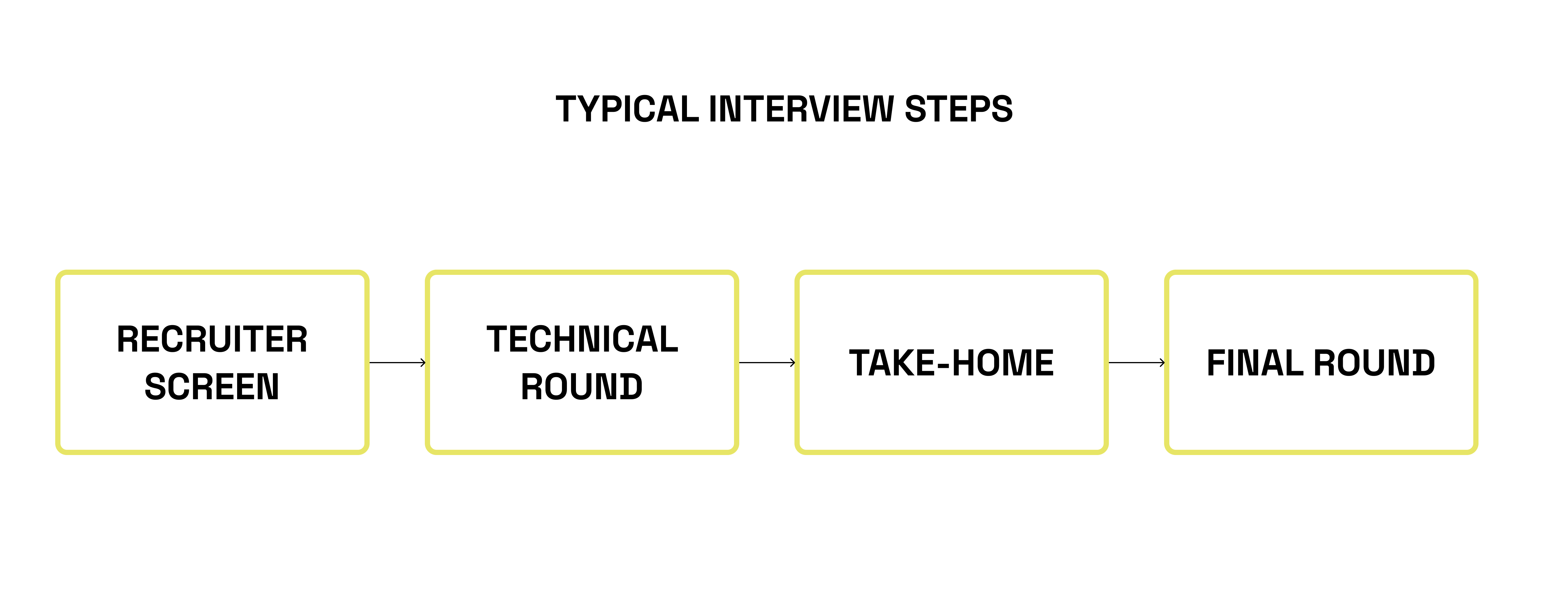
To evaluate these dimensions, most companies use a multi-step interview process. Each company may have their own way of structuring the interview, but it usually includes some combination of the following four rounds:
Recruiter screen
Technical round
Take-home assignment
Stakeholder / final round
Not every company may use all four, but I’ve seen those patterns quite a few times.
The funnel reality
The funnel can be brutal. A typical analytics engineering role may receive 100+ applications:
20–40 candidates pass the recruiter screen
10–20 reach the technical and take-home stages
2–5 make it to the final round
1 receives an offer
That’s the reality of the current market.
Let’s walk through each stage and what interviewers look for.
Recruiter/HR screening

The recruiter (or HR) screen is usually a 20–30 minute call designed to answer two questions:
Should we keep investing time in this candidate?
Are we aligned on logistics (salary, conditions, etc)?
Typical questions include:
“Tell me about your background”
Focus on your current role, scope, tech stack, and why you work as an analytics engineer.
“Why do you want to work here?”
Talk about the product, domain, team, or growth opportunities.
Avoid speaking negatively about your current company — that’s a common red flag.
“Have you used X?”
Questions about SQL, dbt, orchestration tools, or analytics platforms.
Logistics
Salary expectations, start date, work authorization, location, etc.
“Do you have any questions for me?”
This matters more than people think. Good questions signal seniority and reduce the risk of mismatch.
Preparation tips:
Prepare concise answers (1–2 minutes each)
Avoid heavy technical jargon — recruiters are usually non-technical
Prepare thoughtful questions about responsibilities, impact, and success criteria
Finally, make sure the role is actually a good fit. Job descriptions can be vague or overloaded with non-AE responsibilities. To align the job description with the role, check out my article about the role of analytics engineer where I talk about responsibilities and skills.
Technical round

This round evaluates your technical foundation. The better you perform here, the higher your chances of moving forward and getting the offer.
SQL skills
SQL is a hard requirement. If you fail here, you won’t pass the round.
You’ll usually see two formats:
1. Conceptual questions
Difference between
UNIONandUNION ALLTypes of joins and when to use them
Window functions and common use cases
How to debug a slow query
2. Live coding / whiteboarding
You’re given a schema or dataset
You answer business questions using SQL
You’re expected to ask clarifying questions
You can practice with curated SQL problem sets (e.g. LeetCode SQL tracks) or even better — mock interviews with another person.
Data modeling
Data modeling questions are core to analytics engineering interviews. Interviewers want to see whether you can:
Define business entities (users, orders, sessions, subscriptions)
Choose the correct grain and primary keys
Separate facts and dimensions
Handle slowly changing attributes
Design models that work well for BI and analytics
Typical prompts include:
“Design an e-commerce analytics data mart”
“Model subscriptions with upgrades, downgrades, and churn”
“How would you build reporting tables from events, orders, and marketing spend?”
“How would you model MRR or retention?”
dbt / transformation workflows
Even if the company doesn’t use dbt explicitly, they test the same concepts:
Layered modeling (staging → intermediate → marts)
Testing (uniqueness, not null, relationships, accepted values)
Incremental models
Documentation and its importance
Debugging broken models or failing tests
The technical round usually lasts 1–2 hours and combines SQL, data modeling, and transformation questions.
Take-home assignment

The take-home assignment tests how well you apply your skills in practice.
You’re typically given:
A mock dataset
A realistic but scoped business problem
A well-designed assignment should take ~3 hours.
For example, in a gaming company, you might be asked to model telemetry data (players, sessions, matches, transactions) and help the Product team understand engagement, retention, and monetization.
Some assignments are very explicit about outputs. Others are intentionally vague — part of the test is deciding what to measure.
You’ll usually be evaluated on:
Correctness — are your metrics and conclusions sound?
Data modeling — structure, naming, conventions
Data quality — tests, validation, deduplication
Communication — README, explanations, storytelling
Engineering judgment — maintainability and scalability
Clean, well-explained solutions almost always beat over-engineered ones.
Stakeholders/final round

This round evaluates whether you can turn messy business context into a clear analytics plan. It usually feels more like a working session with a Product Manager or Head of Data than a test.
Common themes:
“Tell me about a project …” — it could be a real or fictional case, where you’d have to talk about aligning with business stakeholders, clarifying requirements, reasoning trade-offs and driving the adoption of the project
Metric definition and investigation
“How would you investigate a metric drop?”
“Define a metric of success for a feature X”
Stakeholder communication and pushback
“How do you handle a stakeholder who wants a metric ASAP?”
“How do you push back when a request doesn’t make sense?”
Data trust, governance, and consistency
“How do you ensure metrics are consistent across teams?”
“How do you ensure data quality?”
While listening to your answers, interviewers implicitly assessing:
Do you communicate clearly?
Do you show clarity and ownership?
Are you a pragmatic or perfectionist?
How you deal with uncertainty and pressure?
Whether you’ll escalate issues early or quietly struggle?
To sum up, in the stakeholder round, companies are checking whether you can clarify the decision, align on metric definitions, communicate tradeoffs, and end with a concrete recommendation. Red flags are jumping into SQL, being vague about definitions, and failing to tie your work to adoption and impact.
Final words
Preparing for an analytics engineering interview is a lot of work. And I hope my article helped you to understand what companies are actually looking for — and how to prepare intentionally for each stage.
If you want to prepare together, I'm running a live bootcamp that covers these topics in depth with practical examples and feedback. I'll share real interview prompts and help you build confidence for the interview process.
The bootcamp starts on January 20.
Subscribe here and follow on LinkedIn to learn more about analytics engineering!

Data modeling is very tricky, and more often than not, the right answer depends on clarifying questions... It reminds me of John Travolta's character age calculation in the movie Phenomenon.